
Rainwater Tank Plumbing Basics for Adelaide Homes: A Design Guide
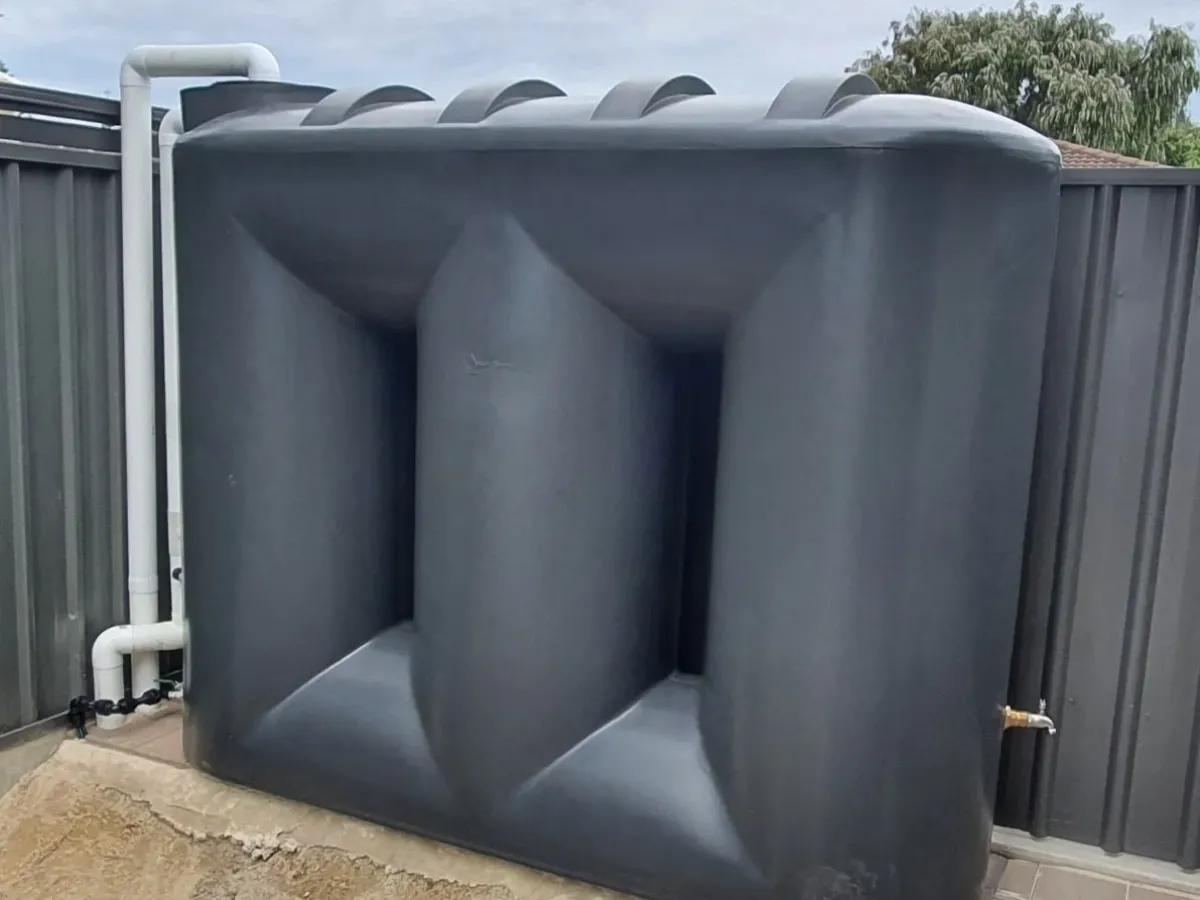
A good rainwater system isn't just a tank in the corner of the yard. It's a small bit of plumbing engineering, and when it's set up properly it'll quietly save you water and money for decades. Set up poorly, you'll spend the next ten years dealing with overflows, pump faults, and sediment in your toilets.
Whether you're building new or retrofitting an existing home, the same five design questions come up every time. Here's what we look at on every job.
How Big Should the Tank Actually Be?
The easy mistake is to buy the biggest tank that fits the spot. The right answer is to match the tank to two numbers: how much rain your roof catches, and how much water you'll actually use.
Roof catchment is straightforward maths:
Roof area (m²) × rainfall (mm) × 0.85 runoff factor = potential litres captured.
So a typical Adelaide home with a 200m² roof, in a year that delivers Adelaide's long-term average of around 545mm, has the potential to capture roughly 92,000 litres annually. That sounds like a lot until you realise a household using rainwater for toilets, laundry, and the garden can easily get through 60–80 litres per person per day.
The practical rule we use:
- 1,000–2,000L tank: garden use only, supplementary watering
- 3,000–5,000L tank: garden plus one or two indoor uses (toilet or laundry cold tap)
- 10,000L+ tank: serious household supply (multiple indoor connections, drought buffer)
- 22,500L+ underground or modular: whole-of-house including hot water, with mains backup
Adelaide rainfall is concentrated in winter (June alone averages around 80mm), so tank capacity needs to carry you through the dry months from December to March when the catchment shuts off entirely. Bigger isn't always better, but undersizing is the more common mistake.
First Flush and Filtration: Get the Dirty Stuff Out
The first water that runs off your roof after a dry spell is the dirtiest: bird droppings, dust, leaf debris, the lot. If that goes straight into your tank, you've got a problem.
A proper rainwater intake system has three layers:
- Leaf basket or gutter guard at the downpipe entry, catching the big stuff before it gets near the tank.
- First-flush diverter, a vertical pipe section that fills with the initial dirty runoff and only lets clean water through to the tank once it's full. Sized at roughly 1 litre per square metre of catchment area, so a 100m² catchment area needs about 100L of diversion capacity.
- Inlet screen at the tank entry, a fine mesh (usually around 1mm) that stops mosquitoes, lizards, and any fine debris that made it past the first two stages.
If you're using rainwater for drinking or hot water, you'll also need cartridge filtration and UV sterilisation, typically 5 micron then 1 micron cartridges downstream of the pump. That's a separate conversation, and not every household needs it, but for outdoor or non-potable indoor uses the three-stage intake is plenty.
Pump Sizing: Pressure and Flow Are Different Things
This is where a lot of DIY installs come unstuck. Buying a pump on price or label power without thinking about what it actually needs to do.
Two numbers matter:
- Pressure (measured in kPa or bar): how hard the water pushes through your pipes. Mains pressure in Adelaide typically sits around 300–500 kPa, and your pump should match that for taps and appliances to feel "normal".
- Flow rate (litres per minute): how much water the pump can deliver at once. A single garden tap might only need 15–20 L/min, but if someone's flushing the toilet while another tap's running, you need closer to 40–50 L/min.
For garden-only setups, a basic 600–800W pressure pump is usually plenty. For indoor use across multiple outlets, look at a 1,000W+ pump with a built-in pressure controller and dry-run protection. The dry-run feature is non-negotiable. Without it, the pump will burn out the first time the tank empties without anyone noticing.
If you want seamless changeover to mains water when the tank's empty, you'll need a rain-to-mains switching device (sometimes called a "rain bank" or auto-changeover unit). These connect both supplies and prioritise rainwater while falling back to mains when the tank runs dry.
Overflow: This One Catches People Out
Your tank will overflow. Not might. It will. In a heavy Adelaide downpour, a 5,000L tank can fill in a couple of hours and then overflow for the rest of the storm.
The overflow needs to:
- Be the same size or larger than the inlet: a small overflow on a big inlet just creates a backup that floods the gutter system.
- Connect into the stormwater system: don't just dump water at the base of the tank. We've pulled out plenty of tanks where the previous installer left the overflow as an open pipe, and the resulting erosion has undermined the slab the tank sits on.
- Include a mosquito-proof flap or screen to stop critters going up the overflow and into the tank.
If you don't have a stormwater connection nearby, the overflow needs to discharge to a soakage pit sized for your roof area and soil type, not just splash onto the lawn. Tank overflow is really just one piece of a property's whole-of-block drainage; our complete guide to stormwater management in Adelaide covers how the pieces fit together.
Access: Plan for Maintenance Now, Not Later
A tank that's bricked into a tight corner with no clearance is a tank that won't get serviced. Every two or three years you'll want to:
- Inspect the inlet screen and first-flush diverter
- Check the pump and pressure controller
- Clean accumulated sediment from the base of the tank
- Confirm the overflow is clear
Plan for at least 600mm of clear space around the tank for inspection, with the lid accessible without climbing. The pump and any switching gear should be reachable without disconnecting plumbing, ideally in a small enclosure on the ground beside the tank, not buried in the back of a garden shed.
Don't Forget Compliance
Tank design and installation in South Australia falls under AS/NZS 3500 (the National Plumbing and Drainage Code) plus your local council's rules. Some councils require a minimum tank size on new builds, mandate specific indoor connections, or restrict where the tank can be visually located on the property. There are also fire-safety considerations in bushfire-prone areas, which we covered in detail in our rainwater tank fire safety regulations post.
If you're building new, talk to your builder about rainwater requirements before the slab goes down. Retrofitting plumbing connections is always more expensive than getting them right the first time.
The Short Version
If you're planning a rainwater system, work through these in order:
- Calculate your catchment and pick a tank size that matches your real demand
- Spec a three-stage intake: leaf basket, first flush, inlet screen
- Pick a pump rated for your pressure and flow needs, with dry-run protection
- Connect the overflow to stormwater (not the lawn) at the same size as the inlet
- Leave 600mm clearance around the tank for future maintenance
Get those five right and the rest is just plumbing.
Thinking about installing or upgrading a rainwater system? Get in touch with Stormwater Plus for a site assessment. We'll size, spec, and install a rainwater harvesting system that's right for your roof, your demand, and your block. We've designed setups from single-tank garden supply through to whole-of-house systems with underground storage, and we'll tell you straight what your property actually needs.